Politics
Angie Nixon beats Alex Vindman in Florida Senate primary
Angie Nixon won Florida's Democratic Senate primary 56.1% to 43.9%. USA Times' calculation puts Vindman's campaign at $28.92 raised per vote received against Nixon's $1.38.
Angie Nixon, a state representative from Jacksonville and a member of the Democratic Socialists of America, won Florida's Democratic Senate primary on August 18 with 705,835 votes to Alex Vindman's 553,138, a margin of 56.1% to 43.9%.
Vindman, the retired Army lieutenant colonel whose testimony in the 2019 impeachment hearings made him a national figure, had been recruited into the race by the Democratic Senatorial Campaign Committee and was treated as the presumptive nominee throughout. He raised more than $16 million. Nixon raised about $975,000.
On the reported figures, Vindman's campaign took in roughly $28.92 for every vote he received, and Nixon's took in about $1.38 for every vote she received, a gap of 21 to one in cost per vote in favour of the candidate who lost. That is the clearest single measure of what happened in Florida on Tuesday.
What the numbers actually say
| Alex Vindman | Angie Nixon | |
|---|---|---|
| Reported fundraising | more than $16.0 million | about $975,000 |
| Votes | 553,138 | 705,835 |
| Vote share | 43.9% | 56.1% |
| Share of the two campaigns' money | 94.3% | 5.7% |
| Money raised per vote received | about $28.92 | about $1.38 |
Sources: fundraising as reported by NBC News; vote totals from the certified Democratic primary result. Per-vote figures and money shares calculated by USA Times. Vindman's fundraising is reported as a floor, so his per-vote figure is a minimum.

Read across the chart and the inversion is complete. Vindman held 94.3% of the money the two campaigns raised between them and took 43.9% of the vote. A sixteen-to-one advantage in resources produced a twelve-point defeat.
There was no public polling in the race before Tuesday, as NOTUS reported, which is itself informative: nobody was spending money to measure a contest that was assumed to be settled. Florida broke for Donald Trump by double digits in 2024, and a Democratic Senate primary in a state the party has largely stopped contesting is exactly the kind of race that goes unmeasured until the returns come in.
Why money underperformed here
The structural explanation is turnout. A late-August primary in a non-presidential year draws a small, self-selecting electorate, and in that environment the marginal value of advertising falls while the marginal value of contact rises. Nixon ran what NOTUS described as a robust ground operation. A ground operation converts the people it reaches; television reaches people who do not vote in August.
The second explanation is candidate fit, and it is the one national party committees keep relearning. Nixon spent the campaign pointing out that Vindman had only recently moved to Florida. She is a former union organiser and a lifelong Jacksonville resident, and her closing message was aimed directly at the way he entered the race: "Florida: the choice is OURS. We will decide our future, not billionaire donors or the establishment politics of DC."
Vindman is the latest figure from the first Trump term to find that national recognition earned in Washington does not convert into votes in a state party primary. Name recognition tells voters who you are. It does not tell them why you are on their ballot.
The general election is a different problem
Nixon now faces Republican Senator Ashley Moody, who won her own primary comfortably on the same night, in a state where no Democrat has won a statewide federal race in a decade.
Moody moved immediately to define the contest, telling supporters that Nixon wants to "destroy this country and everything that it is built on" and that Florida is "staring down crazy and the socialists." The National Republican Senatorial Committee was blunter: "Florida will never elect a socialist to the US Senate."
The Democratic Senatorial Campaign Committee, which had recruited the losing candidate, endorsed the winner within hours. Chuck Schumer and Kirsten Gillibrand issued a joint statement calling Nixon "a lifelong native of Jacksonville and a former union organizer" whose "dedication to put working families first runs deep," and attacking Moody's record on health care.
Vindman conceded without complaint, saying Nixon "ran a strong campaign" and that he would be "standing by her side in the fight against Ashley Moody." Nixon, for her part, told his supporters there was "a place for you" in her campaign, adding that "we are not trying to force everyone to agree with us and believe exactly the same thing."
Her platform is not a general-election platform in the conventional Florida sense. She campaigned on Medicare for All, universal child care, affordable housing, fully funded public education and "an end to senseless wars," and she has advocated cutting US aid to Israel, a position with particular weight in the state with the country's third-largest Jewish population.
What this result is evidence of, and what it is not
A primary electorate of 1.26 million voters in a state of 23 million is not a referendum on anything, and the useful lesson here is narrower than either party's messaging suggests: in a low-turnout primary, organisation beats spending, and it beats it by a wide enough margin that a sixteen-to-one money advantage did not close a twelve-point gap.
What the result does not establish is how any of this performs in November, when the electorate is several times larger, the opponent is an incumbent Republican, and the money advantage will run in the other direction. The two contests test different things. Nixon has proven she can assemble a coalition inside a Democratic primary in August. Whether that coalition scales to a Florida general election is an open question, and the honest answer on August 28 is that nobody has data on it.
The other open question belongs to the DSCC. It recruited a candidate, funded him at a level rarely seen for a Florida Democrat, and watched him lose by twelve points to someone who raised less than a million dollars. The committee will contest other primaries this cycle. What it concludes from this one is the more consequential story.
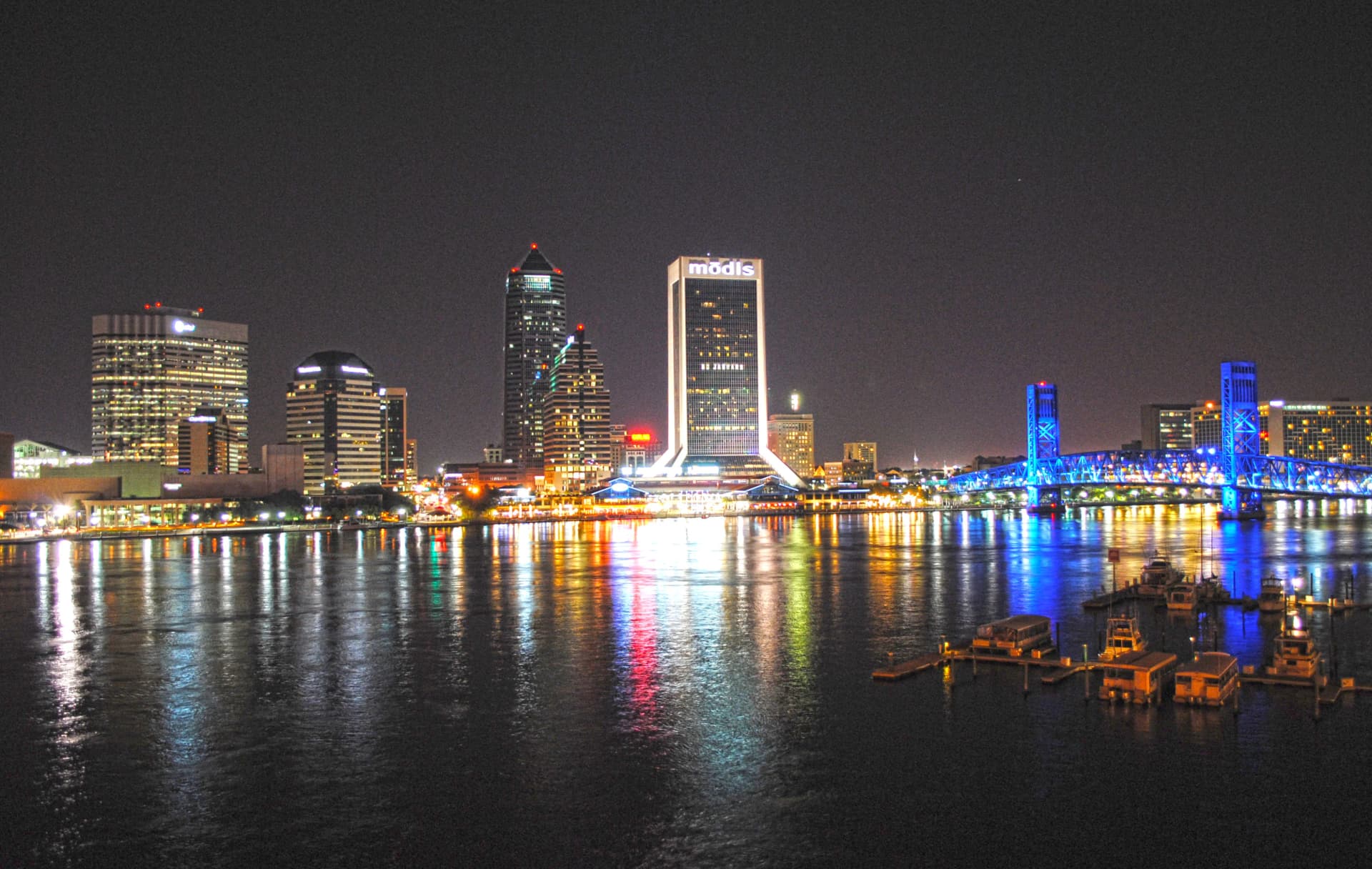
Cover photograph: downtown Jacksonville, Florida, Angie Nixon's home city and legislative base. Photograph by AndrewAvitus, released under CC0, via Wikimedia Commons.
About the author
Ellen Marsh
Ellen Marsh is the national editor at USA Times, directing coverage of Washington, the states, and the federal courts.
Keep reading
More from USA Times

Bessent launches global Iran sanctions as US gas hits $4.09
Treasury's Operation Economic Outcast threatens Iran's trading partners worldwide. USA Times sets the campaign against EIA pump prices: US gasoline is up $1.15 a gallon in six months.
Ellen Marsh / August 28, 2026

Liquid nitrogen seeps onto Pluto, New Horizons data show
An SwRI study led by Alan Stern finds liquid nitrogen rising through cracks in Pluto's Sputnik Planitia, the first evidence of recent liquid flow on the dwarf planet.
Priya Raghavan / August 28, 2026

NFL opens on a Wednesday with nine games abroad in 2026
The 2026 NFL season starts Wednesday, September 9 with Seattle hosting New England. USA Times counts nine of 272 games, 3.3% of the season, played in seven countries.
Priya Raghavan / August 28, 2026